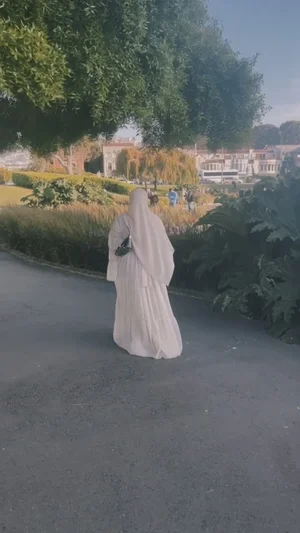
What If the Plan Was Never Yours to Control?
Soulful Smiles 02
﷽
In the name of Allah, the Most Gracious, the Most Merciful
Assalāmu alaykum (Peace be upon you) my beloved. I pray you are well and in the best state of mind, body and heart.
There's a version of me from a few years ago who had it all mapped out. The timeline, the plan, the this-will-happen-then-that-will-happen, I could've handed you a slideshow. And then, piece by piece, life did what life does. Not cruelly. Just... differently than I'd imagined. I remember sitting with that disappointment, not quite grief and not quite peace, wondering: if Allah is writing this, why does it feel like the pen slipped?
I don't think I'm alone in that moment. Most of us have stood at the edge of a plan that unraveled , a job that didn't come through, a relationship that ended before we were ready, a prayer that seemed to go unanswered for far too long. And in that space between what we hoped for and what actually happened, we're handed a quiet, uncomfortable invitation to let go.
This is tawakkul, not the passive shrug of "whatever happens, happens," but something far more alive. It's doing everything within your power and then opening your hands. When I think of tawakkul, I am reminded of three prophetic stories, the stories of Prophets Ibrahim (Abraham), Yunus (Jonah), and Ya'qub (Jacob), peace be upon them. In their stories, we see three different faces of that letting go, i.e., trust in total uncertainty, trust after a stumble, and trust in outcomes we can't yet see the wisdom in.
I. Trust in Total Uncertainty
Ibrahim (AS) leaves his wife Hajar and their infant son Ismail in a valley with no water, no people, no shade, just sand and silence. He turns to walk away. And Hajar, understandably, follows him, asking again and again, "Where are you going? Are you leaving us here with nothing?"
He doesn't answer. Not out of coldness, I think it's because he can't. What do you say to the woman you love when you're being asked to trust something that makes no sense to you either?
So she asks one more question, but this time it's different: "Did Allah command you to do this?"
He says yes. And she says,
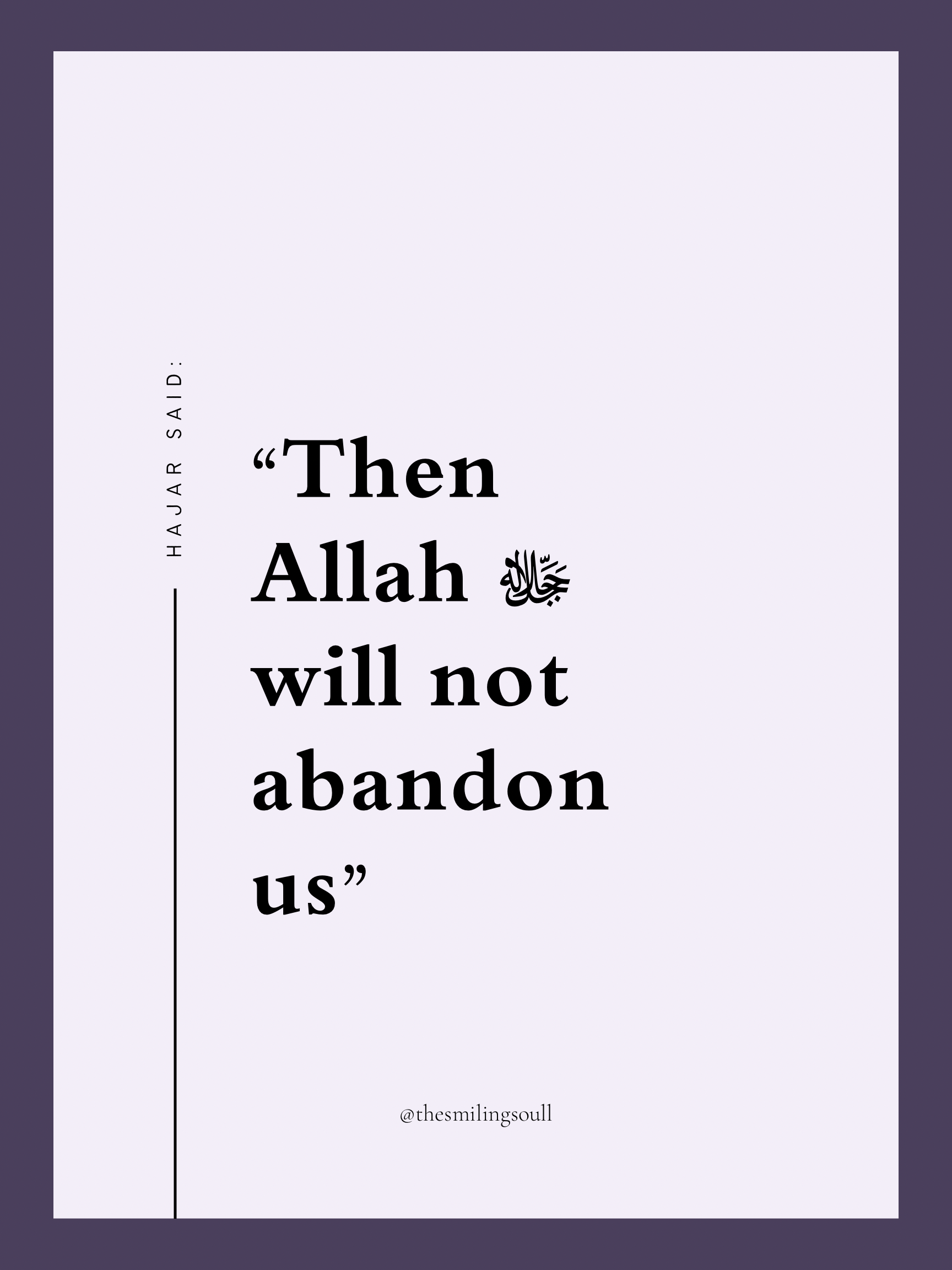
I sit with that line every time I read it. There was no further protest. No demand for a backup plan. Just, if this is from Allah, that's enough. She still has to act, though, this isn't the end of her effort, it's the beginning of it. She runs between Safa and Marwa seven times, searching, exhausting every option in front of her. And it's in the middle of that searching, not after she's given up, that the ground opens beneath Ismail's feet and Zamzam begins to flow.
That's the shape of trust in total uncertainty. You don't get the plan. You don't get the timeline. You barely get an explanation. What you get is a single thread, this is from Allah, and you hold onto it while you keep moving your feet.
For us, this might look like: taking the interview even when you don't know if the job will work out. Sending the application. Making the du'a. Not because you can see the outcome, but because you trust the One who commanded the effort in the first place.
II. Trust After a Stumble
Yunus (AS) didn't get his story right the first time. He left his people before Allah gave him permission to leave, frustrated with their rejection, and boarded a ship. A storm hit. Lots were drawn to decide who'd be thrown overboard to lighten the load, and his name came up. He was swallowed by a whale, and in that darkness, pitch black inside the belly of a fish, inside the darkness of the sea, inside the night itself, he made one of the most quoted du'as in the Qur'an: "Lā ilāha illā anta, subḥānaka, innī kuntu minaẓ-ẓālimīn", There is no god but You, glory be to You, I have indeed been among the wrongdoers.
I love this story because it doesn't start with him getting tawakkul right. It starts with him running. And Allah doesn't respond to that running with abandonment, He responds with a whale that becomes, strangely, a place of return rather than a place of punishment.
What strikes me most is what Yunus (AS) doesn't say in that du'a. He doesn't bargain. He doesn't ask to be freed first. He acknowledges his own shortcoming and glorifies Allah, in that order, and trusts that whatever comes after that admission is already the right response.
This is the tawakkul so many of us actually need to hear about, not the version where you trust perfectly from the start, but the version where you've already made the mistake, already run from something you shouldn't have, and you're wondering if it's too late to come back. It is not. The return itself, lā ilāha illā anta (There’s no god but You), is the letting go. You're not required to have earned your way back into trust. You're only required to turn around.
III. Trust in Outcomes We Can't Yet See
Ya'qub (AS) lost his son Yusuf twice, in a way. First to his brothers' jealousy and a well in the middle of nowhere, and then again, years later, to a false accusation that cost Yusuf his freedom. In between, Ya'qub wept. Not quietly, not for a day or two, the Qur'an tells us his eyes turned white from grief, that he carried this sorrow for years without knowing if his son was alive or dead.
And still, in the middle of that grief, he says something that I think gets misunderstood: "fa ṣabrun jamīl", so, beautiful patience. We sometimes read this as Ya'qub suppressing his pain, putting on a brave face. I don't think that's it at all. He's crying the entire time. He tells his sons plainly, "I only complain of my anguish and my grief to Allah." He's not hiding the grief; he's just refusing to let the grief become despair. Those are two different things. Beautiful patience isn't the absence of tears. It's trusting Allah while the tears are still falling.
This, to me, is the hardest form of tawakkul, because it doesn't resolve quickly. Ibrahim's test was a moment. Yunus's was a night. Ya'qub's stretched across years, with no sign, no update, nothing but the ache of not knowing. And it isn't until the very end of the story, Yusuf is alive, a ruler in Egypt, the family is reunited, that the wisdom becomes visible. For years, Ya'qub had to trust a plan whose shape he could not see.
That's usually the part of tawakkul we skip past in conversation, because it's the least comfortable. We want the Zamzam moment, the whale-releases-you moment. We don't always talk about the years in between, the ones where nothing is resolved yet and you're just... still trusting. Still weeping. Still making du'a. Ya'qub's story tells us that's allowed. That's not a failure of faith. That might be the most honest form it takes.
IV. Finding the Balance
It would be easy to read these three stories and walk away thinking tawakkul means doing nothing, that trust and effort live on opposite ends of a spectrum, and the more spiritual option is to simply stop trying. But look again at what actually happened in each story. Hajar didn't sit down in the sand and wait to die; she ran between two hills seven times, searching. Yunus didn't just accept his fate inside the whale; he made du'a, actively turning back to Allah rather than passively waiting out the darkness. Ya'qub didn't stop hoping or stop sending his sons to search for Yusuf; he kept saying, "go and inquire," even in his grief.
This is exactly what the Prophet ﷺ meant when a man asked him whether he should tie his camel or trust in Allah, and he replied, "Tie your camel, and then trust in Allah." Tawakkul was never meant to replace effort, it was meant to relieve you of the burden of controlling the outcome. You tie the camel. You take the interview. You send the du'a upward. And then, the part that's actually hard: you let the rest be Allah's.
I think the real objection we as a people have, even if we don't say it out loud, is something like: if I truly surrender, doesn't that mean I stop caring about what happens? But Ya'qub's tears answer that question honestly. He surrendered and he wept. He trusted and he still felt the full weight of not knowing. Tawakkul was never sold to us as emotional numbness. It doesn't ask you to perform peace you don't feel. It asks you to keep turning toward Allah while the feeling is still there, which, if anything, is harder than pretending not to feel it at all.
And maybe that's the piece our current moment, one that praises certainty, five-year plans, and "manifesting" your way to guaranteed outcomes, makes hardest to hold. We're taught that control is a virtue, that uncertainty is a problem to be solved rather than a state to be trusted through. These three Prophets show something different: that peace was never on the other side of certainty. It was available the entire time, in the tying of the camel and the opening of the hands, at once.
V. What Ibtisam Today Will Say to Ibtisam Then
I think about that version of me again, the one with the slideshow-perfect plan, sitting in the wreckage of what didn't happen the way I'd mapped it out. If I could sit with her now, I don't think I'd hand her a five-step plan for coping. I think I'd just tell her about three men who trusted before they could see why.
I'd tell her about Ibrahim, left in a valley with nothing but a single sentence to hold onto, this is from Allah, and how that was enough. I'd tell her about Yunus, who ran first and returned after, and how the return itself was the whole point. And I'd tell her about Ya'qub, who wept for years without an answer, and whose tears were never a failure of faith, they were faith, fully lived, right alongside the trust.
None of them got the outcome first and then trusted. They trusted first, in the dark, in the not-knowing, in the years without a sign. And that, I think, is the real invitation in this idea of tawakkul, not to wait until we understand the plan to trust it, but to trust it precisely because we don't.
So if your plans have unraveled lately, if the timeline slipped, if the du'a hasn't been answered yet, if you're still in the valley or still in the belly of the whale or still waiting for the years to make sense, I don't have a neat resolution for you. I just have this: tie your camel. Do your part. And then open your hands.
O Allah, I ask You for good thoughts of You in every state.
I pray wherever your plans have gone quiet, may you find that the silence was never abandonment. May you find, like Hajar did, that He was never going to leave you there with nothing.
With a Smile,
Ibtisam
The Smiling Soul